Lots going on at the Telephone Building

December 2, 2012
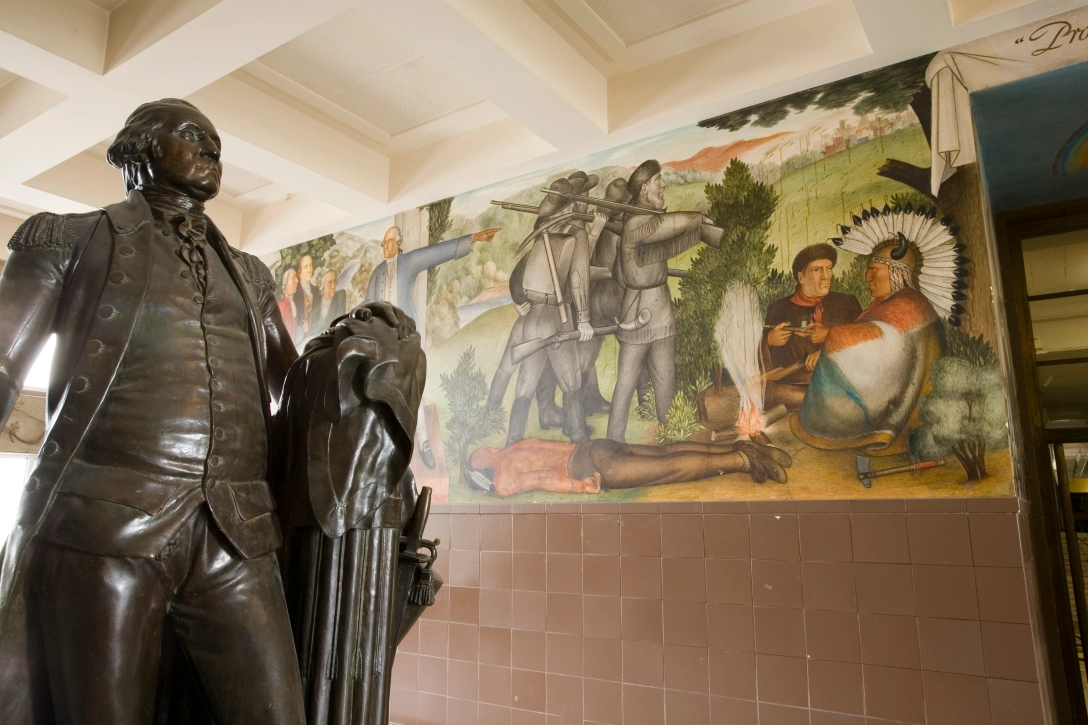
Miller & Pflueger's Telephone Building, (c) Tom Paiva Photography

Miller & Pflueger’s Telephone Building, (c) Tom Paiva Photography

There has been a lot of speculation about potential tenants for the Telephone Building since construction began in March on a major renovation project, which I wrote about in the Wall Street Journal. The $50 million-plus restoration and seismic retrofit of Timothy Pflueger’s iconic Jazz Age skyscraper, which has been vacant for about six years, is underway. Owners Wilson Meany Sullivan have also redubbed the building “140″ - a nod to the nickname given the building by Pacific Telephone & Telegraph Co.  An icon since it was completed in 1925, the skyscraper at 140 New Montgomery Street now even has its own very cool website, a promotion video and photo collage of architectural details.

The base is now covered in scaffolding so it’s hard to peek inside and a construction crane lords over the building (see photo below.) The Timothy Pflueger Blog apologizes for not keeping readers au courant with all the news. In addition, the San Francisco City Guides Downtown Deco tour will talk about the building from across the street, until the work is done.

Construction work on the Telephone Building

Construction work on the Telephone Building

Since construction began, some major tenants have signed up. The biggest is Yelp Inc., which announced plans in May to move into the 26-story building, and lease eight floors, or 100,000 square feet, when the work is finished next year. Tthe San Francisco Chronicle reported in November that the popular Web-based review site’s lease is through 2021. Approximately 800 Yelpers will move in.

Restaurants to move in 

Now, the two public spaces off the lobby have also been leased. In late October, the Chronicle reported that Mourad Lahlou, the owner and chef of Aziza, a well-regarded Moroccan restaurant in the Richmond District, has leased the larger space on the Minna side of the building. This restaurant will also feature the Michelin-rated chef’s take on Moroccan cuisine.  Bar Agricole’s Thad Vogler has leased the smaller space.

While both leases are exciting for local foodies, it is not clear what the news means in terms of architecture. A look at photos of the other locations operated by Lahlou and Vogler respectively has the Timothy Pflueger Blog worrying that both of these venues will go down the path of the trendy, industrial warehouse-chic look.

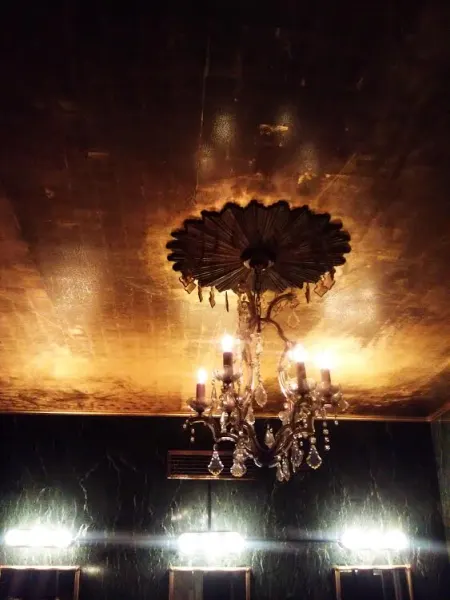
Telephone Building Lobby, (c) Tom Paiva Photography

Telephone Building Lobby, (c) Tom Paiva Photography

Lahlou has hired Olle Lundberg, a San Francisco architect to design the new space, where, the Chronicle gushed, ”exposed brick and concrete abound.” That’s not exactly how it was designed by architect Timothy Pflueger and his draftsmen, as one can see by the dark marble walls, detailed metal work, and the multi-colored plaster ceiling with Chinese motif in the stunning lobby. Many of the building’s interior office spaces are being gutted down to the brick walls to suit the needs of tech trendoids. To be fair, the last time I was in the ground floor space Lahlou is leasing, it was a museum for Pacific Telephone and did not seem to have any remarkable interior details, except for the 12-foot high windows.  The architects had likely focused their attention on the public lobby space.

Lundberg has a great opportunity to go beyond the tired industrial look and create a fabulous and exotic restaurant space evocative of the spirit of the 1920s. Fans of Pflueger and the building hope that he might seek to reference or incorporate Pflueger’s unique take on the Art Deco style, or even study some of his other works, such as the Moorish-inspired Alhambra Theatre on Polk Street, the high Art Deco Paramount in Oakland or his fabulous cocktail lounges from the 1930s, for inspiration. But Lahlou told the Chronicle’s blog, Inside Scoop:  “I don’t want the space to be a shrine,” Lahlou said. “I want a good vibe, good music.” And if Lundberg’s previous (and I should add well-regarded) work is an example, his is an ultra clean-lined, almost antiseptic approach to modernism, but he is also known for liking to work with his hands.

Perhaps there is more hope for the Whiteside Company, the proposed name for Vogler’s new location, which will be an all-day cafe, restaurant and bar. Vogler told “Inside Scoop” that he plans to serve up cocktails from the 19th and early 20th century, considered the Golden Age of the American cocktail, using recipes of one the city’s famous bartenders Bill Boothby. His bar book containing 400 recipes was reprinted by San Francisco’s Anchor Distilling Co. in 2009, with an excellent, well-researched foreward written by Fritz Maytag and David Burkhart of Anchor. Boothby was a bartender at the Palace Hotel, just down the block.

Boothby's American Bartender, published in 2009 by Anchor Distilling

Boothby’s American Bartender, published in 2009 by Anchor Distilling

There are even some examples, most in photographs only, of Pflueger’s stunning cocktail lounges that could serve as inspiration for Vogler’s new venue, should he or his architect decide to incorporate any references to Pflueger. My favorite is the former Patent Leather Lounge at the St. Francis Hotel. If you visit the registration area today you can see the stunning photos by Ansel Adams of the lounge which opened in 1939 with its unusual combination of black patent leather covered walls, carved Lucite ceiling fixtures and long serpentine-shaped bar. The interior of Pflueger’s Top of the Mark has been altered, but the Fairmont Hotel’s Cirque Room is the best extant example of a Pflueger cocktail lounge. While it is now slightly smaller in size, it retains its original circus-themed murals by local artist Esther Bruton, its original long curving bar, built-in banquettes and stunning mirrored columns. You can see Bruton’s circus murals below in a photo from a fabulous Art Deco Society of California party in 2008 for Art Deco San Francisco.

Le Cirque, 2008 book party for “Art Deco San Francisco,” (c) Judth Calson Photography

It’s unlikely either of these two proposed venues at 140 will adopt any kind of Art Deco motif. It would be a lovely surprise if they did, and a nice homage to the building’s architecture. While they are at it, a signature drink named for Pflueger, a cocktail with his favorite spirit, rye, would also be nice.

“Mid-Century By the Bay” book is a must-have

June 9, 2012

Cover for Mid-Century by the Bay by Heather David

If you grew up in the San Francisco Bay Area, or are a fan of the design style and architecture of the mid-century, Heather David’s excellent book, Mid-Century by the Bay is a thoroughly enjoyable stroll down memory lane. David, a San Jose-based freelance writer and cultural historian, is also a Bay Area native, and her 152-page book features a combination of notable local architecture, culture and kitsch. It’s both an informative and nostalgic send-up of the 1950s to 1960s in the Bay Area.

I first stumbled upon this engaging book in the San Francisco Public Library History Center when it debuted in 2010, but after my requested files arrived and I was quickly immersed in my research project of the moment, and forgot about the gem I found.  Last month, I ran into the book again, at the Builders Booksource table at the California Preservation Foundation conference and was lucky enough to also meet the author.

Mid-Century by the Bay is divided into eight main topics, after an introduction of the post-World War II building boom, population and industrial expansion that led to a suburban building frenzy in the Bay Area. The first main section, Bay Area Burbs, covers home design (with some photos of local homes built by Joseph Eichler of course), and the lesser-known Alec Branden, who built over 10,000 homes in Northern California, specializing in traditional and ranch style homes.  Schools, churches and shopping centers are included, with old photos of the then newly built Valley Fair shopping center in Santa Clara and Stonestown in San Francisco, both built in the 1950s. A view of Valley Fair’s once-open courtyard, brick planter boxes and concrete cantilevered roofs creating shady breezeways for shoppers reminded me of my childhood shopping trips with my mom, a big fan of stores such as Joseph Magnin, I. Magnin and Somer & Kaufman.

Photo of IBM Hydro Gyro sculpture at IBM campus in San Jose taken by Arnold Del Carlo, photographer, courtesy Heather David

The “Architecture of the Future” section features some stunning mid-century design in the Bay Area, much of which has been destroyed, or modified as unrecognizable today. As David writes in her epilogue, the Bay Area has suffered from both demolition and “the ’blandification’ of many of its mid-century structures.”  The buildings at IBM Corp.’s Cottle Road campus, designed by architect John Savage Bolles, were accented with brick and multi-colored tiles, the tile pattern mimicking an IBM punch card. Some art that graced the campus is now gone or in disarray, such as the stunning Hyrdo-Gyro sculpture by local artist Robert Boardman Howard, which is now in pieces on the ground. Howard, the son of architect John Galen Howard, also worked with Tim Pflueger on the Paramount Theatre and the San Francisco Stock Exchange.

“Refreshments” captures excellent views of some long-lost iconic local restaurants and popular chains such as Doggie Diner, Zim’s, Lyon’s and the still extant Mel’s (it’s original drive-in restaurant on South Van Ness, though, is long gone. A brochure image has a rarely seen full-color drawing of Pflueger’s Top of the Mark during the 1950s, the original bar still in the center of the room, its rose-toned leather knee cushion still intact, with a band is playing next to the famous bar, and an early version of the dance floor

Another one of my favorite sections is the one called “Bay Area Road Trip,” with photos of some of my long-lost childhood haunts, such as Santa’s Village in Scotts Valley and the Nut Tree in Vacaville. David’s superb collection of ephemera and photos includes a 1960s interior view of the fabulous Nut Tree restaurant (alas the bird aviary isn’t in the scene) and workers in the company kitchen, making sugar sticks and suckers by hand.

SF Modernism show poster, courtesy Penelope Productions

David’s book, like Pierluigi Serraino’s superb NorCalMod, showcases both the simple beauty and the eccentricities of the mid-century and the Bay Area’s rich development during the era. It also calls out the need for more preservation of our most recent past, before we lose even more of it.

David will be signing and selling her book today, June 9, at the San Francisco Modernism show at the Concourse Exhibition Center at 8th and Brannan streets, along with yours truly selling and signing Art Deco San Francisco at a discounted price. If you haven’t yet got a copy of Mid-Century by the Bay, it’s a great deal at $40 and a lovely Father’s Day gift. Come on down.

Castro Theatre saved from fire by SFFD

June 8, 2012

Fire trucks and ladder in front of the Castro Theatre Monday night.

It’s not a sight you want to see. As I came out of the Muni underground at Castro Street earlier this week, police cars were blocking traffic at the corner of Market and Castro, and three fire trucks and their crews were busy in front of Timothy Pflueger’s famous Castro Theatre. Two long ladders were stretched all the way up to the roof of the 1922 building.

A big crowd of concerned neighbors stood anxiously watching the drama from across the street, even though smoke was no longer visible. Rafael Noz, who lives in the Castro, called the theatre “the cathedral of the neighborhood” and he was thankful that the San Francisco Department had the fire under control.

SFFD putting fire out behind the Castro Theatre

A fire department spokeswoman later said that Monday’s fire was a single alarm fire and the SFFD arrived at 7:38 pm, after getting a call from someone in the neighborhood. The theatre, as of late, has been closed on Monday nights. The fire was limited to a small area behind the theatre, and was put out in 20 minutes. “There was trash involved in this fire,” said Mindy Talmadge, public information officer for SFFD. “However, the actual cause of the fire is under investigation.” She added that because the theatre was closed when the fire started, “investigators are looking at this more closely.”

Neighbors in the Castro and worldwide fans of the theatre, which is still owned by the Nassers, the original family who commissioned it, are thankful to the SFFD, and to the vigilant neighbor who called in the emergency, helping avert a major tragedy.

Golden Gate Bridge exhibit shows surprising influences

April 26, 2012

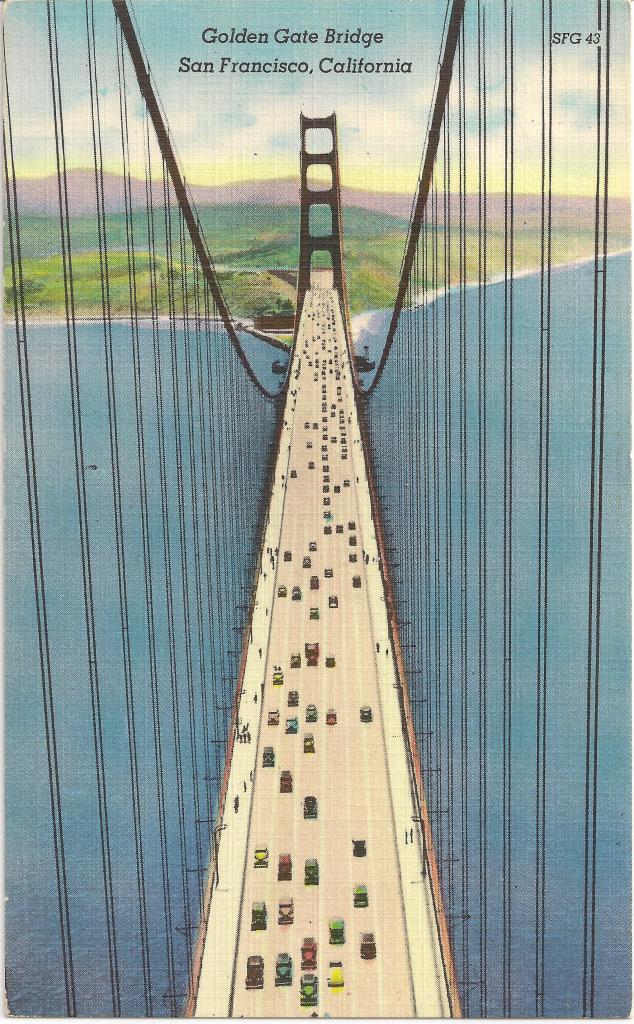
Postcard of the just completed Golden Gate Bridge in 1937

San Francisco’s iconic Golden Gate Bridge will celebrate its 75th year in service next month. Big festivities are planned all over the city, including a “spectacular event” organized by the bridge authority for May 27 at Crissy Field. A special website has all the details for the upcoming Golden Gate Festival. This year, there will be no bridge walk and the landmark will remain open to auto traffic, as officials seek to avoid a replay of the last big anniversary party. 

Locals will undoubtedly remember when the bridge turned 50 in 1987, 800,000 people turned out, when only 50,000 had been expected. The bridge became so overloaded with an estimated 300,000 celebrants that it flattened out in the center. Officials told reporters at the time that ”the bridge had the greatest load factor in its 50-year life” and a paper later written on the event said the suspension cables were “stretched as tight as harp strings.”

Fabulous exhibit at California Historial Society

Before the festivities in late May, there are plenty of ways to start celebrating now, including seeing some local exhibits around town on building the great bridge. One exhibit that will be of interest to architecture fans is a fabulous show on the history and the evolution of the bridge at the California Historical Society. The exhibition, the first under new executive director, Anthea Hartig, is called “A Wild Flight of the Imagination.” The title was borrowed from a promotional pamphlet written in 1922 by chief engineer of the bridge, Joseph Strauss, and city top engineer, Michael O’Shaughnessy. In that brochure, the two, who would later spar when O’Shaughnessy opposed the bridge, wrote that the bridge, once “considered a wild flight of the imagination, has…become a practical proposition.”

The CHS exhibition, which runs until October 14 , is a must-see for anyone interested in the bridge’s fascinating history. Especially intriguing are the fantastic renderings of concepts that were never realized, such as a dramatic Beaux Arts/City Beautiful promenade that would have lead to the bridge, and its not-so-well-known influences.

Influence of the theatre architect John Eberson

One of the most interesting elements of the exhibit is the obvious influence that theatre architect John Eberson had on the bridge from his brief work as a consultant to Strauss.  Eberson is not exactly a household name  but he is well-known to theatre historians as the father of the so-called “atmospheric theatre” and the designer of over 500 theatres around the U.S.

John Eberson’s rendering of the bridge’s suspension tower, circa 1930. Courtesy California Historical Society. Pencil on vellum, on loan from the Architectural Archives, University of Pennsylvania.

One of his more famous theatres in the U.S. is the Loew’s Paradise in the Bronx, New York, which opened in 1929 on the then-thriving Grand Concourse, which was recently restored in 2006. The Paradise was one of his three atmospherics in New York City, in which the architect sought to bring the outside indoors, typically with mechanics and lighting. These theatres often gave audiences the impression of seeing movies under an evening sky, with the moon and clouds moving overhead. Eberson, a native of Austria, worked in St. Louis, Chicago and other cities before moving his office to New York in 1926, according to his obituary in March, 1954 in the New York Times.

Strauss hired Eberson to work on the towers and some of the approaches on the San Francisco side of the bridge. As Kevin Starr described in his 2010 book, Golden Gate:The Life and Times of America’s Greatest Bridge, “the very fact that Strauss initially chose Eberson to stylize the towers and other aspects of the bridge underscores Strauss’s sense of the Golden Gate Bridge as, in part, a theatrical production orchestrating site, structure and atmospheric into a unified aesthetic statement.”

Elevation study of the northern approach to the Golden Gate Bridge, circa 1930, by John Eberson, pencil on vellum. The Architectural Archives, University of Pennsylvania, courtesy of California Historical Society

If all of Eberson’s drawings, or those of his successor, had been realized, there might be a far more dramatic entrance to the bridge, with a grand colonnade or walled portals, which as John King opined in the Chronicle last month, would have been unnecessary ”theatrical trappings,” distractions from the site’s natural beauty. Even so, the dramatic influence of the father of the atmospheric theatre remains today in the bridge’s suspension towers, where the Moderne setbacks in Eberson’s 1930 rendering made it to the completed bridge. According to Starr, Eberson asked for more money to complete the project, but Strauss decided, based partly on a recommendation of local artist Maynard Dixon, and the need to comply with planning changes, to work with Bay Area architect Irving Morrow.

It appears that by August, Morrow & Morrow were fully ensconced in the project, which was still trying to win public approval. An August 1930 article in the San Francisco Chronicle on plans for the bridge getting approved by the bridge district was accompanied by a large photograph of a painting by Dixon that was used to show what the 4,200 foot span would look like in its surroundings. Maynard’s painting was aimed at disproving the increasing opposition that the bridge would mar the natural beauty of the Golden Gate. Irving Morrow noted the controversy at the time. One of his notes, on display in the CHS exhibit, reads: “Sentimentalists tell you it would be a desecration of natural beauty to bridge the Golden Gate,” Morrow wrote. “The point is not whether bridging the Golden Gate will destroy its beauty but whether the particular bridge proposed will destroy it.”

Maynard Dixon painting of the concept of the bridge, 1930, courtesy Golden Gate Bridge, Highway and Transportation District.

By October, 1930,  a series of drawings in the Chronicle’s Sunday photogravure section on October 5 included proposed renderings of the “world’s greatest span,” by Morrow & Morrow Architects. Some echo drawings by Eberson, with a dramatic, neo-classical approach to the bridge on both the San Francisco and the Marin County side. In the drawing of the Marin approach, below,  architect Irving Morrow was influenced by both Eberson’s ideas, and Bernini’s colonnade at St. Peter’s Basilica in Rome, according to architect Donald MacDonald in his 2008 book, “The Golden Gate Bridge: History and Design of an Icon.” Morrow’s design for the San Francisco portal also called for high walls around a large plaza, acting as a wind barrier, and a grand plan for an exhibition hall.
 

Drawings by Morrow & Morrow published in the San Francisco Chronicle, Oct. 5, 1930

 
The exhibit at CHS has several drawings by Eberson, including another approach reminiscent of the Brandenburg Gate in Berlin. But a realignment of the roadway forced a redesign of the San Francisco plaza and money was also an issue. Still it is Eberson’s designs for the 746 feet high suspension towers, that set the tone for the bridge. “Eberson’s design of the towers was very influential I believe,” said Jessica Hough, lead curator of the exhibit. “His tower design was changed very little after Morrow took over as consulting architect.”

The father of the atmospheric theatre may have not worked on any theatres in the Bay Area, but his influence here is profound.  MacDonald, who was the first architect to work on the Golden Gate Bridge after Eberson and Morrow, also notes in his excellent book that Eberson initiated the Art Deco style in the bridge.  The style in the corners of the suspension tower’s bracing also echoes a theatre proscenium, MacDonald notes, as can be seen in this 1930s construction photo from the San Francisco History Center.

North Tower under construction, circa 1930s, courtesy of San Francisco History Center, San Francisco Historical Photo Collection.

The gradual narrowing of the suspension towers as they rise was an improvement to Eberson’s towers by Morrow, according to MacDonald. Eberson’s stepped pattern in the towers also mirrored the gradual stepping of many skyscrapers built in the 1920s, which echo the pyramid shapes of the temples of the Maya and also allowed more light onto city sidewalks. Timothy Pflueger’s Telephone Building at 140 New Montgomery was the first skyscraper in San Francisco to deploy that technique. Chicago architect Louis Sullivan had suggested setbacks as early as 1891, MacDonald points out. But it was Eliel Saarinen’s second place design of a skyscraper with setbacks for the 1922 Chicago Tribune Tower contest that really brought attention to the concept. While Saarinen’s design was not executed, it was the winner in the architecture community, including unflinching praise from the ever-critical Sullivan, and was far more influential than the actual winner.

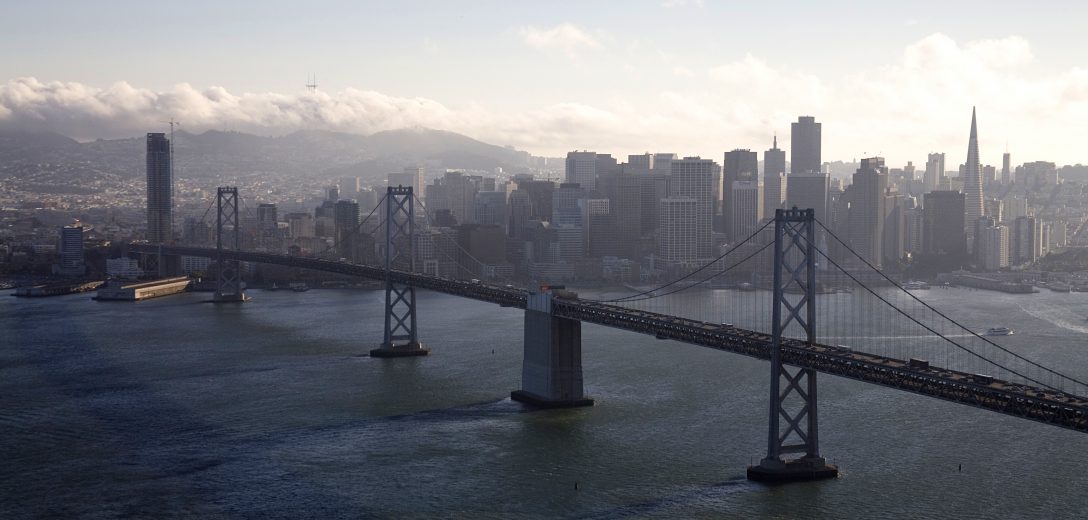
With the influence of both movie palace design and skyscrapers of the Jazz Age, no wonder the Golden Gate Bridge wins all the beauty contests, in contrast to her sister bridge, the Bay Bridge, whose 75th anniversary has not received nearly as much hoopla or attention.

Many other local exhibitions on the Golden Gate Bridge

In addition to the CHS exhibit, the San Francisco History Center on the sixth floor of the main library has a new exhibit called “Bridging Minds: San Francisco Reads, 1933-1937,” featuring books, photographs and ephemera of the period and the works of California authors. San Francisco librarian and author Jim Van Buskirk will be giving talks about movies that have featured the Golden Gate Bridge, which has starred in more movies than any other American architectural icon. Not to be outdone, the Marin History Museum in San Rafael has an exhibition on how the bridge changed life in Marin County featuring construction photos from the renowned Moulin Studios, and photos from local photographer Jeffrey Floyd.

High hopes for New Mission Theatre plans

March 4, 2012

New Mission Theatre, courtesy Jack Tillmany, circa 1943

Local theatre buffs and preservationists have high hopes for a new project to save the New Mission Theatre, which has been empty and languishing for over a decade.

In mid-February, a Texas group called the Alamo Drafthouse Cinema , and Toby Morris of Kerman Morris Architects, made a presentation at the city’s architectural review committee for the complete restoration and rehabilitation of the old theatre. The plans would restore the space to again show movies, but Alamo wants to convert the New Mission into five “boutique” theatres, a concept that has in the past raised the hackles of many theatre buffs.

Alamo Drafthouse also plans to serve higher-margin food and beer. The company is apparently an institution in Austin, where it serves snacks, food and beer to patrons, and is well known for vehemently enforcing its no texting, no talking policy. The only similar concept locally is the Kabuki Sundance Cinema, where patrons can buy beer and wine and food.

An executive from Alamo Drafthouse and architect Morris were saying all the right things at the city’s meeting. “We are movie fans for movie fans,” said Tim Reed, Alamo’s senior vice president of real estate. ”And when you see a gem like the [New] Mission and the ability to go in and bring it back to its heyday and the quality of what it is, it’s very, very exciting. We think what we are going to present to you today is going to be something we can all embrace,” Reed said.

Tortured History

The New Mission is indeed a diamond hidden behind the rough, but it has also had a tortured past. It started out as a nickelodeon called the Idle Hour. In 1915, the owners hired local architects the Reid Brothers, to design a large auditorium and a new lobby, with seats for over 1,700 and a pipe organ that cost $26,000, a massive sum at the time. The theatre opened in 1916 and would become one of many theatres that brothers James and Merritt Reid designed, in addition to their major buildings at the turn of the century, such as the Spreckels Building and the Fairmont Hotel.

In 1932, the theatre’s owners the Nasser Brothers, who also owned the Castro and the Alhambra theatres, hired architect Tim Pflueger to modernize the New Mission, which the Reid Brothers had done in a mostly neo-classical vocabulary. Pflueger added Moderne touches to the main lobby, including some murals in silver leaf, but he mostly left the Reid Brothers auditorium alone. The most pronounced addition by Pflueger is the striking 70-foot high neon vertical, which remains today, albeit in disrepair, and a swank staircase in the main lobby (see photo below).

Pflueger's remodel of the New Mission Theatre, courtesy San Francisco History Center, San Francisco Public Library

Pflueger's remodel of the New Mission Theatre, courtesy Jack Tillmany and the San Francisco History Center, San Francisco Public Library

In 1993, the theatre was shuttered and in 1998, it was purchased by City College of San Francisco, with the intent to build a new campus in the Mission District. But the only token of the theatre that City College wanted to save in its plans was the striking vertical blade. It planned to tear down the theatre, and a preservation battle ensued, one that got nearly as heated as the unsuccessful fight in the 1970s to save the City of Paris department store from the wrecking ball by Neiman Marcus.

This time around, however, preservationists prevailed. In 2001, the theatre was named to the National Register of Historic Places. Instead of working on an adaptive reuse plan with preservationists, the college decided to sell the building and in 2003, sold it to Gus Murad, the owner of the hip rooftop bar, Medjool, in the Mission. Murad planned to turn the theatre into a performance art space, but his project also included expanding and turning the Giant Value store next door into condominiums. After both of these projects hit too many brick walls with the city, Murad is fed up with San Francisco, and reportedly, has put Medjool up for sale.

The Mission Blog reported that Murad is in contract to sell the New Mission to Alamo Drafthouse, but the company is not commenting beyond a blog post by its founder and CEO Tim League and its committee comments. League posted some photos of the theatre which showed its current delapidated condition, but also showed some of its still-extant architectural features.

Reid Brothers auditorium today, photo by Tim League, Alamo Drafthouse

Reid Brothers auditorium of the New Mission Theatre, photo by Tim League, CEO of Alamo Drafthouse Cinema

It’s not clear how much the major project, which includes a seismic retrofit, will cost.

Morris told the architectural review committee that probably the most signficant aspect of the project is a concept of a “floating balcony,” by extending the lower balcony 15 feet toward the screen. This “floating balcony” is where auditoriums 2, 3 and 4 will be located. “We are going to hold the ceiling of the theatre off of the existing historic ceiling to preserve the interior volume and spatial relationships and to enable visibility of the historic ceiling,” Morris said.

Auditorium 5 will be located on the upper balcony, and the domed ceiling will remain intact. A kitchen and new restrooms will be added on the ground floor.

The plans include keeping and restoring as many of the historic details as possible, such as the Reid Brothers’ ornate plaster work. Where features cannot be saved or restored, molds will be made to help the architects and builders recreate the work. Sadly, the Pflueger lobby, also described as the promenade lobby, was described as needing “reconstruction” because of water damage and brick walls which have to be reinforced. The lobby is the oldest part of the building, and the Reid Brothers auditorium is at least made of reinforced concrete. The goal is to save as many of the mural fragments as possible and display them in the Pflueger lobby, possibly in their original location.

Katherine Petrin, an architectural historian at Architectural Resources Group who is also on the board of the San Francisco Neighborhood Theatre Foundation, said the proposed project is “a rehabilitation that is very exciting.” “The San Francisco Neighborhood Theater Foundation is in full support,” she said, adding that ARG is the historical consultant to Morris and had been working on various projects to restore the theatre for years.

As Morris noted in his presentation, “the devil is in the details,” and there may be some obstacles bedeviling this project. Theatre historian and author Jack Tillmany is not as sanguine about the prospects for the New Mission, nor for ACT”s plans to renovate the old Strand Theatre in the Mid-Market area.

“I believe a lot of people get emotional about saving old theaters without considering the economic and social reality of the times, particularly their locations,” Tillmany said. “The unwelcoming – to put it politely – surroundings and deterioration of business life along both Mission Street and Market Street are an often uncommented upon factor that had a lot to do with the demise of both these sites years ago, and, continue today with little sign of immediate or significant improvement.”

But, it would seem that the gritty location of the New Mission is a good fit for the Alamo Drafthouse, which started its first theatre in a warehouse district in Austin, Texas. League brings hope in his blog, noting that he was born in Berkeley, and that San Francisco is his favorite city in the world.  “We still have many permitting and planning hurdles ahead of us, so we don’t have even a target date to get this done,” League said.

Streamline Moderne gem a quiet star in “Dark Passage” at Noir City Film Festival

January 20, 2012
Malloch Building on Montgomery St, where Lauren Bacall lives in “Dark Passage”

Rain has finally descended upon a parched San Francisco, casting a perfect gloomy backdrop just in time for this year’s Noir City Film Festival. Aficionados of the dark film genre are looking forward to this year’s program, where San Francisco plays a role in some of the films, starting tonight at the Castro Theatre. Both familiar and long-gone buildings and structures can be spotted in several films, where our fog-drizzled streets, covert alleys and stairways, and lust-inducing vistas make the city an excellent backdrop for murder, double-crosses, and ill-fated romance.

The festivities kick off with an old favorite, the 1947 film “Dark Passage,” starring Humphrey Bogart and Lauren Bacall. Bogart plays an ex-con on the run after escaping from San Quentin, where he was wrongly jailed for the murder of his wife. Enter Bacall, as Irene Jensen, who lets him hide for awhile at her chic San Francisco apartment on Telegraph Hill. The building her character lives in is one of the best examples of the Streamline Moderne style in the city, the Malloch Building. Streamline Moderne was the sleeker outgrowth of Art Deco that evolved in the 1930s, influenced by a variety of forces.

Look for glimpses of this still-stunning building if you see “Dark Passage” at Noir City X, or anytime you see the film. Completed in 1937, the Malloch Building has a bit of mystery of its own. It was featured in a six-page article in the December 1937 issue of Architect & Engineer, which oddly excluded the name of its architect, and only mentioned the owners/builders, father and son, John and J. Rolph Malloch, and consulting structural engineer, W.H. Ellison. But in the early 1980s, local author and historian extraordinaire Gray Brechin solved the mystery. Brechin discovered the building was designed by little-known local architect named Irvin Goldstine, whom he interviewed for an article in a New York magazine called Metro.

Brechin said that Goldstine did not have his architect’s license at the time he worked on the building, thus why he is not listed as its designer. But while Goldstine, who got his architect’s license in 1940, is not well known, he designed many homes, apartment buildings and commercial structures in San Francisco and on the Peninsula, according to architectural researcher Gary Goss. Brechin noted that while he studied at the Ecole des Beaux-Arts in Paris, he was also influenced by the European modernists such as Le Corbusier and Erich Mendelsohn. The Malloch Building is a gorgeous example of Beaux-Arts planning and an embrace of art, infused with modernism.  The wood-frame building is technically six stories from top to bottom, and Brechin noted that its owners were sued for violating a city ordinance that prohibits wooden-frame structures of over three floors above a garage. But because each floor is stepped and set back, there are no more than three floors at a time above the garage, and the Mallochs won their case.

Scraffito by artist Alfred du Pont

The building, like many Streamline Moderne designs, is slightly evocative of a ship, as it sits perched at the top of the Filbert Steps, which Bogie trudges up in one scene in the movie. Other noteworthy features are its glass blocks, curvilinear lines, sand-blasted glass panels and three 40-foot high scraffito murals on the outside of the building. The then just-completed Bay Bridge is also featured in the mural shown here at the right. The murals, by artist Alfred du Pont, a friend of Goldstine’s, were made by applying colored concrete and carving it into shapes, a technique used in ancient Pompeii. Scraffito, derived from the Italian word for scratch, was also used on the murals that grace the sidewalls of architect Tim Pflueger’s Castro Theatre.

Originally built as an apartment house, all nine units and two penthouses were rented before the Malloch Building was completed, according to Architect & Engineer. “Telegraph Hill offers a certain Bohemian atmosphere that the public has found alluring and success of this particular venture has been an incentive for other investors to plan similar projects in this locality,” the journal wrote. In addition to the gorgeous views of the San Francisco Bay and the gleaming new bridge, tenants could also watch the building of Treasure Island and the Golden Gate International Exposition.

Garden vestibule entrance, courtesy Gregg Lynn, Sotheby's Int'l Realty

Residents enter via a street-level open garden vestibule, where the sand-blasted glass portrays leaping deer or gazelles and exotic foliage, stunningly backlit at night. Interiors were described as including circular dressing rooms, built-in bookcases, and glass brick partitions. Mouldings, baseboards and other non-essentials were eliminated. The dining rooms were circular with open, built-in shelving and every apartment was painted boldly in a different color scheme. Photos of the early interiors show planter boxes built into the glass brick windows, with diffused light shining through, a much sleeker, modern interior than was portrayed in “Dark Passage” when it was filmed 10 years later.

Other venues to watch for in some of the Noir City films include a harrowing drive around Telegraph and Russian Hills and the grounds of the now-shuttered Julius Castle in Friday’s “The House on Telegraph Hill,” a 1951 film. The 1949 “Thieves’ Highway,” was shot in and around the former produce district, which was demolished for Embarcadero Center, and contains some of the best footage of that old market.  Alcatraz and Fort Point both make an appearance in “Point Blank” a 1967 film about a man seeking revenge, starring Lee Marvin and Angie Dickinson. In a special treat, Dickinson will appear Saturday night for an interview on stage with the “Czar of Noir,” festival host, film preservationist and author Eddie Muller. The festival concludes with Bogart, playing the private eye, Sam Spade, in the 1941 version of “The Maltese Falcon.” A key scene in Dashiell Hammett’s 1930 novel takes place on Burritt, the dead-end alley off Bush St., down the block from the alley now known as Timothy Pflueger Place.

The modern elegance of 1360 Montgomery will likely outshine some of the other grittier locations seen in this festival. But there’s a lot to see over the next 10 days, including some long-lost vintage views of San Francisco.

And don’t forget to watch your back.

The El Rey Theatre to come back as a movie palace for a night

October 31, 2011

Ad for the El Rey Theater in November 1931 in the "San Francisco News"

The El Rey Theatre, the former movie palace that still towers over Ocean Avenue and parts of Ingleside Terraces, is turning 80 next month. To celebrate the anniversary, the Voice of Pentecost, which bought the building in 1977, is hosting a fund-raiser, and the organizers will be showing the same film that was featured during the Moderne theatre’s gala opening on November 14, 1931. This time, the movie, “The Smiling Lieutenant,” starring Maurice Chevalier and Claudette Colbert, will be shown in a digital format on a large screen on the stage.

It should be a fun night. The organizers include the Ingleside Light newspaper and the Geneva Car Barn and Powerhouse project. The proceeds from ticket sales, which cost $25 each, are going to benefit the Geneva Car Barn project. The evening begins at 7 pm, with a talk given by architect Joshua Aidlin, whose firm Aidlin Darling Design has prepared plans to restore the Geneva Car Barn and Powerhouse, a non-profit youth arts project. The goal is to turn the 1901 building that powered and housed electric street cars into an exhibition and events hall, with classrooms, an auditorium, kitchen and cafe by 2014.

A brief description of the architecture of the theatre, which was one of the last movie palaces designed by architect Timothy Pflueger, will be discussed by yours truly, with a few photos to compare and contrast the El Rey Theatre with other theatres designed by Pflueger at the same time: the Paramount Theatre in Oakland and the Alameda. One unusual feature of the El Rey is its massive stepped tower, which still stands today at 146-feet high. Once glowing with red and green neon tubing, the tower gave the theatre a skyscraper-like appearance that can still be seen from various spots in Ingleside Terraces. As you can see from this old 1931 ad promoting the opening, when the theatre was complete it had a beacon at the top, which was used to warn airplanes of the tower in the fog. The beacon also seems to have served as a built-in klieg light for the surrounding neighborhoods West of Twin Peaks.The El Rey’s big birthday party will be celebrated at the theatre at 1970 Ocean Avenue on Saturday, November 19 from 7 pm til 10 pm, with food, wine and live music. For more info, email info@elrey80th.com or call 415-215-4246.

Don’t miss this rare chance to see a film in the old movie palace again. “The Smiling Lieutenant” was also nominated for Best Production, the early Academy Awards equivalent of Best Film, in 1931.   In addition, authors and theatre experts Jack Tillmany and Gary Lee Parks will be joining me in selling our theatre-related books at special discounts to attendees (Tillmany has written Theatres of San Francisco and Theatres of Oakland, and Parks has written Theatres of San Jose).  A new book that they co-authored,  Theatres of the San Francisco Peninsula, recently published by Arcadia with many photos from Tillmany’s collection, will also be available.  All of these theatre books, and my Art Deco San Francisco: The Architecture of Timothy Pflueger, make excellent holiday gifts.

Sun dial in Ingleside Terraces, with the El Rey tower seen beyond the trees.

It’s de-lightful, it’s de-lovely, it’s Deco in New York

August 20, 2011

Ceiling mural in the lobby of the Chrysler Building

Cole Porter please forgive me for messing up your lyrics, but last month I had a kind of late 1920s, early 1930s week in New York. After seeing the Broadway revival of “Anything Goes,” I still can’t get Porter’s witty lyrics out of my head. And they meld so well with many of the city’s glorious Art Deco icons, the most glamorous of all, of course, is the Chrysler Building, designed by architect William Van Alen and completed in 1930. The race between the builders and the architects of the Chrysler Building, who were competing with the Empire State Building and the Bank of the Manhattan Co. at 40 Wall Street to build the world’s tallest skyscraper, is well-documented in the 2003 book “Higher” by Neal Bascomb, a great read.

Both the Chrysler and the Empire State still have their original stunning lobbies, that were part of the Roaring Twenties flamboyance, even though those happy, crazy times were nearing an end, unbeknownst to the architects and owners at the time.  The  Chrysler lobby has an immense ceiling mural by artist Edward Trumbull.  This shot is of only a small portion of the vast 97-by-110 foot ceiling mural, called “Energy, Result, Workmanship and Transportation.”  The mural was restored by EverGreene Painting Studios in New York in 1999, when the details of the ceiling were hidden by an aged polyurethane coating over the murals.

In July, 1930, The New York Times advised its readers in a story about an exhibition at the Brooklyn Museum, to visit the “ordinary vestibules” of two newly completed buildings, the Daily News Building and the Chrysler, to see some excellent art work.  On my visit this summer, in addition to seeing the ceiling mural, Moroccan red marble walls in the lobby, the famous clock and other details, I was able to get close to the elevator doors while I was visiting someone in the building.

Gorgeous Chrysler Building Elevator Door

The elevator doors have a veneer of exotic woods, fashioned into a stylized floral pattern or a fan. Up close they are truly stunning and according to the book, New York, 1930, they are made of Japanese ash, English gray harewood and Asian walnut. Inside the elevators, the cabs include American walnut, dye-ebonized wood, satinwood, Cuban plum-pudding wood and curly maple. The interiors of all the elevator cabs are different.

The tale of the career of architect William Van Alen, who was called the “Ziegfield of his profession” in American Architect in September, 1930, is a sad one. His career didn’t go much farther after the completion of the Chrysler Building, thanks in part to the Great Depression.

Chrysler Building from the New York Public Library

His career was also hurt by the fact hat he had to sue Walter Chrysler for the bulk of his fee. He famously dressed for the Beaux Arts Ball in New York wearing an imitation of the crown of his best-known building. Its steel-covered dome was made of chromium nickel sheet steel panels. The material, called Norosta, was made according to German methods for the first time in th U.S., and the bulk of the work was done in metal working shops set up on the 67th and 75th floors of the Chrysler Building, while it was under construction, according to an article Van Alen authored for The Architectural Forum in October, 1930. Sadly, Van Alen died in 1954 leaving a widow, but no children and his office records have never been found.

The mystery of the Gilded Age architect and his artist brother

June 18, 2011

The Pissis brothers worked together on the 1905 Sherith Israel Temple

Albert Pissis was one of San Francisco’s most respected architects from the Gilded Age to the post-fire building boom. To me, he is also one of the era’s more quietly fascinating figures in local architecture, described after his death as having been a man of “dominating will power,” “naturally reserved,” but frank in expressing his opinion, even to “the extent of criticizing his own work.”

Pissis was born in Guaymas, Mexico in 1852, but his family moved to the scrappy town of San Francisco when he was around six. He gradually rose from a designer of rather typical Victorian homes to become a force in local architectural circles. He helped bring a sense of order learned at the Ecole des Beaux-Arts in Paris at a time of architectural chaos in the young metropolis.

In addition to his work, including landmarks like the Flood Building and the Hibernia Bank, his client and personal relationships have intrigued me. But Pissis is hard to research. His office files burned in the 1906 earthquake and fire. The firm’s work post-fire was considerable but those records,  passed on after Pissis’ death in 1914 to his successor, Morris M. Bruce, cannot be found.

Pissis was the oldest of five children born to a French physician and his Mexican wife. One aspect of his life that is murky was his relationship with his brother Emile, who was two years younger. Emile also had a creative gene, and became an artist. But they rarely worked together, even in an era of growing appreciation for the arts and culture in a city that was keen on labeling itself as the Paris of the West.

While researching an article on Pissis and the Hibernia Bank for the San Francisco Historical Society’s journal, The Argonaut, I  began to wonder if Albert and Emile had a falling out later in life.

Albert Pissis circa 1880s, courtesy Alex Finn

The two must have been close, at least in their early years and part of their adult life. But even though Emile was a talented artist, it has struck me as odd that they worked on only a few known projects together: a home in Pacific Heights, and the temple for Congregation Sherith Israel on California and Webster streets, completed in 1905. Emile designed many of the art glass windows for the Byzantine-Romanesque temple. The windows are now more visible (see photos) as a result of a major renovation and seismic retrofit, which has also included removing the salmon colored paint and restoring the building’s Colusa sandstone exterior. The dome is next on the list for paint removal.

Historians only re-discovered Emile Pissis’ involvement in the temple several years ago, after finding a receipt for payment  to him for the art glass windows in the Sherith Israel archives. Emile is not mentioned in any newspaper articles at the time of the September, 1905 opening of the temple. Albert Pissis is cited as the architect, along with frescoes by artist Attilio Moretti. An excellent doctorate dissertation on Pissis and Arthur Brown, Jr. in 1986 by historian Christopher Nelson discusses Emile’s art glass windows.

Exterior view of art glass by Emile Pissis depicting Moses

Emile Pissis, the artist and agitator

Emile studied art in Paris, while Albert was studying architecture at the Ecole. Upon their return to San Francisco, Emile worked for about 16 years at various importing firms, as a clerk and then a bookkeeper, possibly through connections in the French community.  Based on listings in San Francisco City Directories, around 1888, Emile was able to stop working, perhaps aided with his share of his father’s estate, and focus on his art.

In 1890, Emile returned to Paris for a few more years. By January, 1894, he was back in San Francisco, and mentioned in The Morning Call as one of 10 local artists, including Arthur Mathews, who were contemplating sending their work to exhibit at the Midwinter Fair in Golden Gate Park. He was living in the family home, by then on California Street and listed as “artist” in the city directories. 

He also rented a studio downtown on Sutter Street for a couple of years, and played a vocal role in the goings-on at the San Francisco Art Association in its early days in the mansion built by railroad magnate Mark Hopkins. In 1893, Edward Searles, who had married Hopkins’ widow Mary, donated the Nob Hill manse after her death to the artists’ group. The sprawling Victorian was renamed the Mark Hopkins Institute of Art and a glowing article in The Argonaut in 1905 described it as “a permanent home of a most picturesque and beautiful character.”

The House Gallery, Mark Hopkins Institute of Art, The Argonaut, Jan. 9, 1905

Emile Pissis did not agree.  In an article in the San Francisco Call on February 15, 1895, he complained about the poor lighting in the dark hallway of the mansion, the exhibition space for the artists who were students at the Art Association’s California School of Design. Pissis said he had shown a large number of paintings in a previous exhibit but that they were “killed” by the shadows and he would not exhibit again.

An obituary in the San Francisco Examiner in 1934 stated that Emile Pissis did not sell a single painting and exhibited rarely. But his involvement in the early days of the art association shows that he was quite passionate about his profession and active in helping local artists get recognition, and make sales. He was also credited with coming up with ways to help foster sales of works of fellow students at exhibitions.  Another article in The Morning Call on an artists’ meeting at the institute, in which he grilled the director on whether any paintings sold at the last exhibit, labeled him “Pertinent Pissis.”

Despite Emile’s protests about the dark gallery space, he did show his work again. In 1896, he placed third behind local legends, Arthur Mathews and William Keith, first and second prize winners, respectively, in a contest commissioned by James Phelan for scenes from California’s history.

A Room of His Own

In what appears to be the last collaborative effort with his brother Albert, in 1895 Emile commissioned Pissis & Moore to design an apartment building on the corner of Pleasant and Taylor streets on Nob Hill. Their father Joseph had dabbled in real estate, and his sons inherited his aptitude. Emile’s art studio formed the penthouse of a building consisting of three flats, with its own separate entrance on Pleasant Street. The entire building cost $8669, according to California Architect & Building News in 1895.

Pissis must have been the envy of the San Francisco artist community. The Call  ran a piece on September 3, 1895 about his plans. “The real workroom will consist of a large apartment 18 feet high, with light from all four sides, the northern windows being the largest, however. All the light will be adjustable, and will come from windows situated near the ceiling,” the Call wrote. “The decorations have not yet been decided upon, but to artists, these are a minor detail. It is the excellent facilities which the studio will offer for working in all weathers that is making the owners of extemporized studios talk with just a tinge of envy when they chance to mention Emile Pissis’ name.”

Nob Hill building once owned by Emile Pissis, by Bakewell & Brown

Sadly, no drawings of the building Albert Pissis designed for his brother have been found. The building burned in 1906, along with most of Emile’s paintings at the time. During the city’s rebuilding, Emile enlisted the young firm of Bakewell & Brown, now known for their neo-Baroque splendor that is San Francisco City Hall. Their 1909 building stands today at the corner of Pleasant and Taylor. Emile lived the rest of his life at No. 18 Pleasant Street, with rentals providing him with a mostly steady income. This building also nearly burned down: in 1933 a fireman had to smash down two doors to rescue the elderly Pissis in his penthouse from a raging fire.

Why didn’t Albert design the second iteration of Emile’s apartment building and art studio? Perhaps he was too busy during the post-1906 building boom, where he played a major role designing many downtown business buildings and new stores for the city’s retailers like the White House. He perhaps recommended the young architect Arthur Brown, Jr.  if he had no time to help his brother.

18 Pleasant Street, where Emile Pissis lived

Le Mysterieux
 
But an interesting fact has emerged about Emile. He wrote many “Letters to the Editor” of The Argonaut, the weekly literary paper, under a pseudonym, Lemice Terrieux II, a play on le mysterieux, which means the mysterious one in French. The Argonaut wrote a brief obituary of Emile Pissis, in which the editors unveiled his true identity, and said he had been writing for the weekly for 40 years. But the first letters that could be found signed Lemice Terrieux II are from the late 1920s, in which he opined about everything from politics to Prohibition to the economy to the local art scene.
 
The most intriguing of his writings, however, is a series of articles he wrote on life in “Old California,” a charming series that also mentions many French pioneers, with the notable exception of anyone in the Pissis family, perhaps to keep his identity secret. In one amusing piece, he talks about how the alleys of Belden Street and Morton Street (now Maiden Lane) were also “dedicated to the cult of Venus.” 

“These were the educational grounds of the youths of those days, where they became sophisticated sexually,” wrote Lemice Terrieux II, on August, 3, 1929.

Another article on August 24, 1929 is even more interesting for what it says about Emile’s view of his brother’s contribution to San Francisco’s architecture. Looking back fondly on the old days, he cast a rather disparaging eye on some of his brother’s most important buildings, including the 1892 Hibernia Bank that propelled Albert’s career. Written near the end of the city’s Jazz Age skyscraper building boom, Emile blamed some of his brother’s works for ushering in a “Stone Age” of  granite buildings and ending the city’s quirky architectural mayhem in wood and iron.

Emile Pissis, from his obituary, San Francisco Examiner, June 11, 1934

“The erection of the Emporium, the Flood building, and the Hibernia bank, marked the end of the cast-iron architecture which had prevailed in San Francisco,” he wrote. “It was the beginning of the Stone Age in the city’s construction, of the skyscraper and the brick facades – it was the beginning of new San Francisco and the end of the old city, of its originality, of its charm.”  He went on, “The city of today is a diminutive New York, a dwarf Chicago – its redeeming features: its seven hills, its bay and its ocean cliffs and shore.”

Were these just the idealized reminiscences of an old man, or did Emile express them to his brother while he was alive? It is perhaps worth noting that when Albert Pissis died, he left his entire estate to his wife, Georgia Pissis, whom he married in 1905. His estate, estimated at around $500,000 in 1914, was large especially for an architect, and the Architect & Engineer said he was the city’s wealthiest architect.  Pissis, like his father, had also amassed local real estate holdings, stocks and bonds, and even had a chauffeur.

But neither of Albert Pissis’ three living siblings at the time of his death, Emile, his other brother Eugene, and Margaret Gallois, nor his sister’s children, were mentioned in his brief wills, one dated 1908 another dated 1911. Of course, it’s standard to leave an entire estate to one’s spouse. But the will’s complete omission of Albert’s younger artist brother and other family members, is still an interesting, if puzzling, fact. 

Some good architecture reads for spring

May 4, 2011

Cover of John King's very portable book, "Cityscapes"

Let’s face it. You can’t really lug a serious book about architecture to the beach, or even on the bus. Typically they are either hefty, hardback tomes, made even heavier by glossy, full-color pages of photography of the work being discussed, or they can venture into dry, academic treatises that often aren’t really fun to read.

This spring, though, fans of architecture can find some good books on our city, including one that you can easily carry on local walking expeditions. San Francisco Chronicle architecture critic John King has just come out with a very readable and portable book, “Cityscapes” (Heydey, 111 pages, $14.95).

Chronicle readers will recognize the buildings here as having appeared in brief homage in King’s Sunday column, “Cityscape.” The book presents 50 San Francisco buildings in all-too-brief description, and excellent photos, all taken by King for his column, with input from his editors and photographers at the newspaper. King, a two-time finalist for the Pulitzer Prize in criticism, can write.  Readers who missed these columns will be engaged by his elegant prose; some may be flummoxed by a few of his unusual selections.

King knows that his choices may cause preservationists some pause. “This book makes no claim to be a definitive roster of San Francisco’s finest or most beloved works of architecture,” King writes in the introduction. “Instead, look on it as fifty facets of our urban scene: the charismatic stars and the background players; buildings defined by bold visual moves and buildings that offer tactile delight; the sort of structure you notice every time you pass by, and the sort that escapes notice until you catch it at a certain angle, in a certain light.”

That is probably my favorite aspect of this little book, which is also very affordable at $15. It captures buildings in a new light, and shares lovely aspects of some seemingly bland or unloved structures: the “pearly stucco” facade of the garage at 450 South Street, the “brooding grandeur of the rough concrete” of the brutalist Glen Park BART Station, the “clattering, metallic beast” that is the San Francisco Federal Building. Just last week I walked by the Flatiron Building in the morning sun and looked up at the  cornice and its “splashy parade of Gothic embroidery” which I hadn’t noticed in such detail before. One of my favorite city garages, George Applegarth’s circular Downtown Center Garage on Mason Street, is called an “unapologetic ode to automotive convenience” in a town where cars are scorned.

Kelham

Architect Timothy Pflueger’s work appears twice, with both the Telephone Building and Roosevelt Middle School gracing its pages. So does the work of his contemporary George Kelham, and many other local architects, both revered and not so well known. (My quibble is that Kelham’s Shell Building gets treatment as an icon over Pflueger’s earlier Telephone Building). Author Jacquie Proctor will be pleased to see that the subject of her most recent book, architect Harold Stoner, appears twice, including a nice shot of his Lakeside mini-tower, which King calls a “streamlined explanation point.”

Cityscapes gives local architecture fans new looks at both stalwarts and underappreciated structures. King has been on the lecture circuit around the city, and has an upcoming talk and book signing at the Mechanics’ Institute Library, that gem of an institution at 57 Post Street, designed by Albert Pissis. King will be at the Mechanics’ Institute on Thursday, May 19, at 6 pm. On Tuesday, May 31, he will be at SPUR, 654 Mission Street, at 6 pm.

"Port City" by Michael Corbett

Preservationists will love Port City.

The anticipated history of San Francisco’s port is finally available. Published this year by San Francisco Architectural Heritage, Port City, written by Michael R. Corbett, is a comprehensive history of the city’s waterfront and its buildings.  (San Francisco Architectural Heritage, 248 pages, $65 non-members, $52 members).
 
It’s a timely book, coming as it does ahead of the America’s Cup in 2013, and it includes a catalog of the port’s historic resources. As Heritage Executive Director Mike Buhler notes in the preservation group’s spring newsletter, “the race organizers are receiving development rights to a large swath of Port property in exchange for investing up to $80 million to ready some of its historic piers for the regatta.” Debates over the plans are sure to ensue, but at least Port City now provides a frame of historical reference.  Buhler cautions though that, “significant questions remain including how to pass rigorous state environmental review, and the scrutiny of diverse stakeholders, within such a compressed timeframe.”
 
The book by architectural historian Corbett evolved from the 500-page nomination and subsequent listing of the Port of San Francisco to the National Register of Historic Places. A 3-mile section of the most in tact, early 20th century finger-pier waterfront in the U.S.  was named a historic district in 2006. Architectural historians Marjorie Dobkin and William Kostura  worked with Corbett on the nomination. The book received funding from firms like Plant Construction, the city’s preservation fund committee, San Francisco Waterfront Partners and individuals.
 
Telling the long history of the evolution of the Port of San Francisco is no easy feat, spanning from 1848 to 2010 as the book does in 248 pages. The sometimes dry text is offset by vivid vintage and contemporary photography and large, full-color maps. From the early creation of the seawall, the arrival of the transcontinental railroad, the infamous labor disputes of the 1930s, to its irreversible decline after World War II and the triumphant reinvention of the Ferry Building, the port’s history is integral to the city’s.
 
This gorgeous coffee-table sized book also makes me want a new, updated edition of my dog-eared paperback of Splendid Survivors, the prior publishing venture in 1979 by Heritage, also written by Corbett. Just as Splendid Survivors is a  must-read for every student of the city’s architectural history, the even better-produced Port City will likely end up as another must-have. 


Follow

Get every new post delivered to your Inbox.

Join 132 other followers

%d bloggers like this: